

“Start late, leave early” is some of the most repeated advice in writing. And some of the least explained. Because, sure, “start late.” But how late? And “leave early,” but when is that?
Where you start and end a scene shapes your pacing. And pacing defines whether your reader keeps turning pages or “takes a break,” which can lead them to not open the book for weeks.
In this article, I bring to you another analysis piece on popular writing advice that needs more context, so you can start applying it to your story.
Table of contents
What’s a scene?
What does “start late, leave early” mean?
How to start a scene in a book
How to end a scene in a book
Author’s note✍️
I love writing about questions you have along your writing journey. Partly because it helps me with my own book and partly because so much writing advice gets repeated without any context… which makes it difficult to apply.
This article started as a three-part question from MyJewishBookshelf (who I call “dude”). She asked me to write about three things:
Setting description (live now!)
Scene transitions and “start late, leave early”
Character interiority
We’re on part two and in her own words:
“Scene transitions — you know how they say if your scene is A B C D E, start with B and end before E? Yeah. So, have you found any tips on starting a scene late enough that you get to the juice fast but not too late that it’s all HUH??”
And well, the more I researched this topic, the more I realized this is a two-part question. So, to give you a stronger article on each, I’ll cover the “start late, leave early” advice in this one and more about scene transitions in the next one.
Consider this part two of four now ✌
I hope you like this one, dude!
What’s a scene?
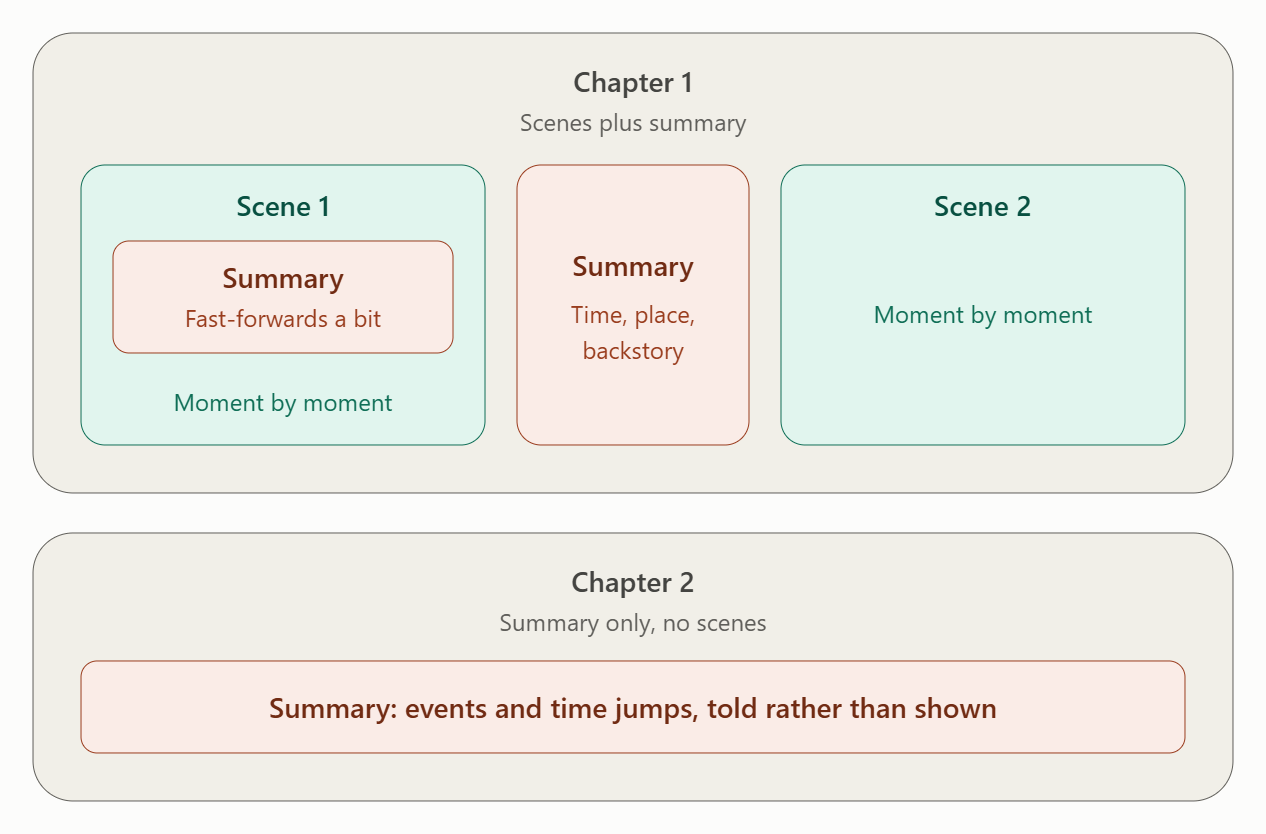
A scene is an event or segment of your story that plays out moment by moment. The “moment by moment” part is what makes it different from a summary.
In a summary, you might write “they argued over how to run the shop for weeks.” In a scene, you show the actual argument, line by line.
Of course, there’s nothing wrong with adding a summary within a scene. Knowing when to show and when to tell is the heart of the “show, don’t tell” advice, which we already demystified a while back.
So, let’s continue with some other basics.
A chapter can hold one scene, several scenes, or sometimes just a summary. If you had to picture it, it would be something similar to the image below:
(This image was AI-generated)
Now because chapters can contain one or multiple scenes, the “start late, leave early” advice applies to them as well.
Which invites the question: how do you know when you’re changing scenes within chapters?
Well, I’d say most of us know instinctively. Readers (and writers) generally feel the shift when the location, time, or point-of-view character changes. Every scene comes with two decisions: where you start and when you end it.
And “start late, leave early” is the piece of writing advice that answers both.
What does “start late, leave early” mean?
“Start late” means the scene should start as close to the main event as possible. “Leave early” means you should finish the scene as soon as it’s achieved its goal.
In our day-to-day, every event comes with padding. For example, arriving at a location, saying “hi,” exchanging pleasantries, the dreaded small talk (ugh), and saying “goodbye.”
In fiction writing, this advice is about cutting all of that.
If your scene is A-B-C-D-E, then:
A is the padding before (arriving, pleasantries, small talk)
B to D is the main event (conflict or development)
E is the padding after (leaving, goodbyes, wind-down; keep this last one in mind)
You should cut A and E. They’re not necessary for your scene. BUT, you still have to give enough context to ground your reader. Otherwise, they land in the middle of an argument between your characters with no idea where they are (describing the setting is important here!) or why everyone is yelling and getting stabbed.
Important note💡
The advice of “start late, leave early” is often attributed to screenwriting professor Syd Field. But it has been widely used in fiction writing too.
You’ve probably noticed how in movies or shows characters answer the phone, get straight to the point, and hang up. No pleasantries. It’s because of this advice.
And because this advice comes from film, it doesn’t account for describing the setting. In a movie, we already see the setting (who’s there, the time of day, and where). In writing, we have to ground the reader.
How to start a scene in a book
To start a scene in your book, you need to understand what the main event is and know what context is important.
This comes down to answering two questions:
Where is B (your main event)?
How much information does the reader need to not get lost?
A practical tip for this is to just write the whole scene, from A to E. When you’re done, identify your A.
Common A’s can include:
Your character waking up (we all know this trope)
Getting ready and driving to the location
Greetings and small talk
Once you have your A, cut it paragraph by paragraph. If the scene stops making sense, you’ve gone a little too far. So put the last cut back, and that’s your B.
Make sure you include a short setting or grounding section before or during the main event. That’s what keeps the scene making sense, even when you skip ahead. And getting those details down as early as you can gives you room to jump into the juice of the story without worrying about your reader’s sanity or them going “huh?”
So, that’s getting in.
Now onto the other half of the advice, which is knowing when to get out.
How to end a scene in a book
Every scene has a job, whether that be a revelation, a twist, raising stakes, or getting your character in (or out) of trouble. Once that job is done, the scene is over.
With a caveat…
You should end your scenes with a question, not an answer.
Your E is usually the aftermath or wind-down of the scene. Not only the goodbyes. During E, your characters process what just happened. They come to understand something or even form a conclusion.
Which is why you should cut it 🔪.
Because it’s all the better when the reader is the one forming the conclusion or understanding something.
Ending a scene with unsaid feelings or a truth that hasn’t been processed makes the reader want to keep turning pages. They want to learn more. They want to know if their assumptions are correct. And turning the page is the only way to do that.
If you give them a complete end of the scene, well, they can comfortably close the book.
Important note 💡
This advice here doesn’t mean you should never name the feelings or the truth. You could do that in the next chapter… Or not. It all depends on the story you want to tell.
Lastly, let’s briefly talk about cliffhangers.
You could say that “leaving early” is very similar to the advice of ending all your chapters on a cliffhanger. And well, the lines between the two are blurry.
Some advice out there considers what we just discussed on “leaving early” as cliffhangers too. Because things are unresolved and you can only find out by moving forward. Others save the “cliffhanger” term for the big, dramatic moments.
Either way, the difference that matters is that “leaving early” can be quiet. A cliffhanger usually isn’t.
My take on this is that every chapter should have the “leaving early.” But not every chapter should end with a cliffhanger. If every chapter ended on a cliffhanger, readers would get exhausted, and at some point it would stop working.
So, you know what to do: “start late and leave early.” But give your reader enough information to follow along and keep turning pages.
📌Next article is on scene transitions. Until then, which do you struggle more with, starting or ending a scene?
And, as always, if there’s a writing topic you’d like me to cover, drop it in the comments.
And scene
If you made it this far, you’re probably one of those readers who 100% their book. So, thank you for bearing with me until the end :)
If you found this article helpful (either as a writer or a lurker), consider following along as I figure out how to actually write that book.
Take care and keep writing. ✍️
Great article! How to start late / end early isn't often discussed in this much detail.
There's an alternative to keeping 'A' when the scene would be confusing otherwise: The context info can be inserted after the actual scene has begun (but early enough that the reader doesn't feel confused). This can be tricky though, and sometimes the best option really is to add a couple lines of boring scene setting.
This was great, dude, two thumbs up! Cutting paragraph by paragraph and evaluating is good advice — thanks for taking the time and my suggestion!