

Few things are as nerve-wracking in the writing community as being accused of having a self-insert character in your book. “This author just wrote themselves as the hero in their own story” can sound cringe. Amateur even.
At some point, you’re going to look at your main character (or any of your other characters) and notice that maybe they share your sense of humor. Maybe they solve problems the same way you do. Maybe you gave them your job, insecurities, or they say the thing you always wished you could say out loud.
And there’s nothing wrong with any of that. In fact, you may be doing something right.
What this article is about:
Author’s note ✍
While I was writing my book, I came to realize that my protagonist resembled me in some aspects. Some of my other side characters too.
As an overthinker, I spiraled around the idea for days. I considered changing who my characters were and even editing more heavily when I was done with the first draft. I’ve heard the term “self-insert” before, and the backlash other creative works received when they were accused of it.
But the more I thought about it, the more I realized that the story I wanted to tell wouldn’t be the same if I did those changes. And that sometimes, you can put human emotion on the page because you have experienced it yourself first.
What is a self-insert character? (and why nobody is above it)
A self-insert character is when an author puts themselves in the story. Be that as a version of themselves or quite literally themselves.
The mildest version of that, and this is just good character development, is that a character carries some of the author’s own emotions, experiences, or traits. This is widely used as a technique to make stories feel more real. More emotionally resonant. Or, well, make stories feel more human.
Still, self-insert characters often get a bad reputation across the internet because authors inserting themselves into the story can easily tip into wish-fulfillment territory. When this self-insert character has no flaws and is liked by everyone in the story, it becomes very hard not to roll your eyes.
Now, does that mean you should just avoid using your own experiences to create a character?
That self-insert characters are all bad?
That it will always be cringe?
No, a likable character is a character your reader cares about. They want the character to get what they deserve (be that bad or good). And they can only care if the character feels real.
I believe every interesting character you’ve written has a piece of you. Every feeling that they carry feels real because you experienced it first.
It’s the reason why the grief of a character who lost their father in a battle between magical kingdoms forms a lump in your throat. Or why the couple in an enemies-to-lovers, who can’t be together, makes your chest ache (I’m all about the yearning!).
You may have felt that first, maybe on a lower scale. But the feeling is there.
And quite frankly… even some of the best writers AND creatives go for the more fierce version of this self-insertion thing.
Yes, they’ve done it right.
But first let’s talk about the wrong way to do it.
Self-insert: the bad, the ugly, and the cringe
A bad self-insert comes from the idea of wish-fulfillment. Whatever happens to your character, they can always solve it without much trouble. Everything they do is fair, there’s no moral compass that applies to them. No flaws.
They’re just that good. That perfect.
For an example, let’s again use my master necromancer and apprentice from other articles:
The apprentice had been working for her master necromancer for three months now. And she was still very much fed up with the overconfidence and incompetence of her master.
However, everything changed during a routine rising for a client.
Rising the dead was something that necromancers often did… for a limited time, of course. But when the apprentice performed her first rising, the person came back to life. Fully. Color returned to his cheeks, and he breathed for the first time in years.
It was then that the master understood. His apprentice was one of the rarest necromancers. One that could actually revive people, permanently. That kind of magic had been lost for centuries.
And not only that. She spent every Sunday teaching orphans how to read. She donated most of her earnings to the poor. She was also, somehow, fluent in four languages. She was so kind. So beautiful. I’m so talented, ahem, she was. She was so talented.
In here, I’m mostly telling instead of showing and telling to get my point across. But you get it.
I may have exaggerated a bit at the end, but that’s wish fulfillment. The author may think they’re writing a character, but they’re actually writing a fantasy of themselves.
Important note💡
There’s actually a nuance to this… because the wish-fulfillment self-insert has actually worked before. One of the most widely known examples I see mentioned is Eragon by Christopher Paolini.
It’s important to know that Paolini was 15 when he wrote the book, though. But it’s still a loved piece of literature.
Self-insert: the good, the intentional, and the done right
A good self-insert is when you make your character carry experiences that you have experienced yourself, feelings or even traits… but you still treat them as a character.
As I was doing some research for this article, I found a list of terms that people search on the web related to “self-insert character”. Because I have an SEO background, I like to check what funny keywords are around a topic.
This is what I found in one of my searches:
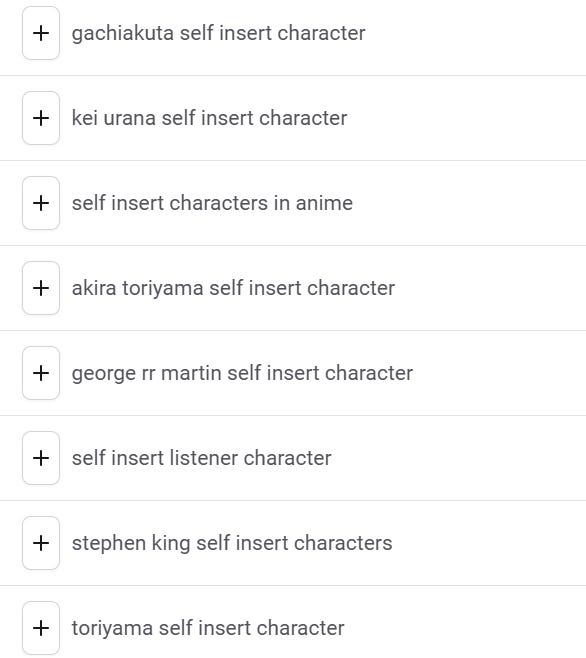
There are many names that you may recognize here from either books or manga. George R. R. Martin (A Song of Ice and Fire), Stephen King (The Dark Tower), and Akira Toriyama (Dragon Ball).
I wanted to include Jane Austen and Agatha Christie in this list, but they never admitted to self-insert. However, it is implied that they did for characters like Elizabeth Bennet (Pride and Prejudice) and Ariadne Oliver, for each author respectively.
But let’s go back to the ones who have confirmed it.
Akira Toriyama as Tori-bot, a playful character
Toriyama literally drew himself as a character in Dragon Ball and some of his other works. But his self-insert works because it was mostly used as a comedic character.

Image source: A Wiki Fandom page
According to some fandom pages, he’s also called “Ultimate Ruler of the Dragon World,” which is a nice wink to the fact that he IS the ultimate ruler because, well, he’s the author.
This one works because it isn’t ego-driven. Just self-aware and playful.
George R. R. Martin as Samwell Tarly, his emotional truth
In an interview conducted by Matthew T. Hall from The San Diego Union-Tribute, Martin has admitted that Samwell Tarly is one of the characters closer to who he really is.
Martin states:
“I would probably be Samwell Tarly. I love Sam, too. He’s a great character…Tyrion might be who I want to be, but Sam is probably closer to who I actually am. The fat kid who likes to read books and doesn’t like to go up a lot of stairs.”
This self-insert works because Samwell Tarly is a character with flaws who also suffers. His father didn’t deign him worthy of being an heir to the point of threatening him with death if he didn’t join the Night’s Watch.
He’s also described as cowardly and timid. Challenges keep coming his way and he doesn’t have it easy, but he grows as a character.
Stephen King as… himself, but fully self-aware
King literally wrote himself as himself in The Dark Tower series. His character’s name in the sixth book, Song of Susannah, is Stephen King, who is also an author and the channel that allows for the writing of The Dark Tower series.
It’s a whole thing with meta and in-universe explanations that may be clearer if you’ve read the books (I haven’t).
But the self-insert works because it makes sense within his multiverse.
All of these examples are different approaches to doing self-insert characters done right. Your self-insert can either be an emotional truth (Samwell Tarly), something funny (Tori-bot), or something else that somehow works.
What’s important is to not create an ego-driven character that makes the story weaker to make room for themselves.
But to create a character that enriches the story because the struggles they experience or the feelings they carry resonate with your reader.
And scene
If you made it this far, you’re probably one of those readers who 100% read their book. So, thank you for bearing with me until the end :)
If you found this article helpful (either as a writer or a lurker), consider following along as I figure out how to actually write that book.
And if there’s a writing topic you’d like me to write about, drop it in the comments.
What’s your take on self-insert characters?
Take care and keep writing. ✍️
I feel like all my self-insert characters tend to inherit my weaknesses instead of my strengths. So at least I've avoided the wish-fulfillment trap anyway. 😂
I would think that to a certain extent everyone's written a self-insert character (even if only partially). I figure that as long as it works, readers care, and it serves the story, then there shouldn't be any qualms with such a character.