

Dialogue is an important element of storytelling in fiction. It makes characters feel genuinely like themselves, moves scenes forward, and gives your readers quote-worthy pieces that they’ll remember long after closing your book.
But how much dialogue is too much?
How do you know when it goes from banter to two talking heads?
And is there a ratio between description and dialogue you can follow?
Well, I did the research for you.
In this article, you’ll get the “benchmarks” and the actual answer that most experts start explaining with an “it depends.”
What this article is about:
Why did “dialogue ratio” become a thing?
The “benchmarks”: what your genre expects roughly
How to actually balance dialogue in a book (the answer)
Author’s note ✍
As most of you know, I’m writing my first fantasy book. Which means I have a very selfish interest in questions like the one Margo Margan posted in the comments of last month’s article on how to write banter.
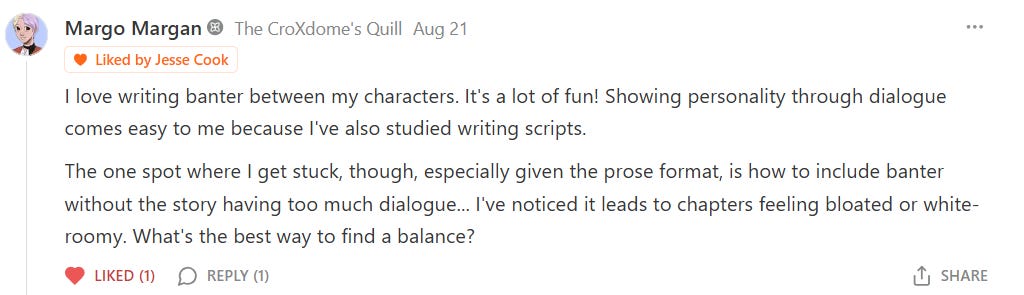
These are the questions I don’t think about… until someone else asks, of course.
Also, the kind of questions that make you really look at your manuscript in a critical way. There’s this idea floating around that the chapters of your book need a “good balance” between dialogue and other elements, without anyone explaining what that balance actually looks like.
So, I went looking for an answer.
Hope you like this one, Margo!
Why did “dialogue ratio” become a thing?
Dialogue ratio became a thing because of the simple fact that it’s measurable. We can feel when a scene is odd. We get annoyed at a book that describes even the most unimportant objects for two pages straight. Or one in which the characters continuously talk about things we don’t care about.
But when teaching the craft, it’s difficult to tell a writer “re-read it, and you’ll feel when it’s too much.”
Naturally, we’re biased about our own work.
No editor is going to say that “the vibes were off” and leave it at that. Instead, they quote ranges. Informally. Just to provide a guideline for emerging writers.
At the end of the day, a writer who has great control over the craft can break all the “rules” and still produce a wonderful piece.
But where are all these “ranges” coming from? And who’s measuring them?
The “benchmarks”: what your genre expects roughly
I went down another rabbit hole for this article.
While the answer to:
“What’s the best way to find a balance between description and dialogue?”
Is most certainly, “it depends.” I wanted to show you the numbers first, so you knew I did the job.
There were a few articles that were giving me ratios. But they were from the years 2012-2015. I wanted something fresher, at least from 2020. The more I searched, the more I found some “it depends” and best practices.
So, I changed my focus to writing software. Those definitely want to be cited for this kind of stuff. Most writing software doesn’t offer the dialogue ratio checker, but the ones that do provided me with good information.
ProWritingAid dialogue ratios
According to ProWritingAid, novels rarely contain under 10% or over 80% of dialogue. This is the benchmark I liked the most because it gives you a lot of room to develop your novel the way you want it.
I’ve read (and enjoyed) books in which most of the story is carried through dialogue and others in which it has been carried through description.
EditRoast dialogue ratios
EditRoast has a tighter dialogue ratio of 35-55% for commercial fiction. However, they also share some ratios for specific genres:
45-70% for thrillers and romance
25-40% for literary fiction
Their argument is that with under 25% of dialogue, it’s difficult for the reader to connect with a character that barely talks. And that the use of continued narration can affect pace while also making the prose dense.
Over 75% of dialogue is more similar to a screenplay. When characters talk too much, there’s no room for atmosphere, interiority, or physical grounding.
Bookshaper dialogue ratios
For Bookshaper, the balance sits more comfortably in the 50/50 spectrum. A novel with 50% being dialogue can carry the reader through the story IF said dialogue has thematic weight.
This was also the most detailed one, as it provided a table of dialogue ranges per genre, which you can see below:
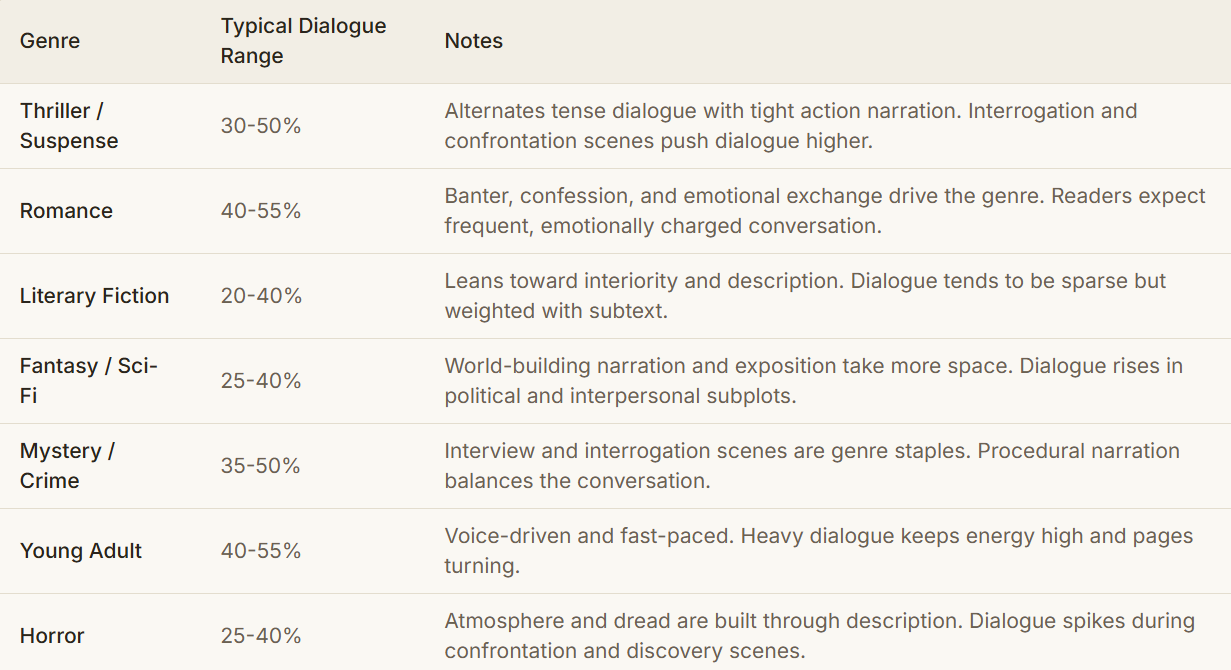
Right now, I’m writing a YA fantasy, so I guess my range of dialogue should be between 25-55%. I’m not sure that’s currently the case. But I sure am tempted to plug my manuscript into one of these tools to see what my ratio is.
How to actually balance dialogue in a book (the answer)
It depends.
(You surely saw that answer coming).
Balance isn’t about how much dialogue is on a page. It’s about whether all the elements (description, action, and interiority) are supporting it and showing up alongside it.
A ratio can be misleading. A chapter at 60% dialogue can feel balanced if the other 40% is doing real work. That can either be grounding the reader, showing the character’s reactions, or letting the atmosphere participate to give the scene texture.
A chapter with 30% dialogue can still feel roomy if the narration is abstract and disembodied from the scene.
To “balance” dialogue in a book:
Make sure dialogue is moving the plot forward (by providing new information or raising the stakes), or developing your character (by revealing their personality or their backstory naturally).
Anchor your reader to the scene (where are the characters? What are they doing? What are their internal reactions?)
Ultimately, there’s not a definite number. Applying these strategies by yourself can still give you a better idea of where you’re at, but it may still be biased.
This is one of the reasons why good beta readers or a professional editor are invaluable.
A good start could also be following at least ProWritingAid’s benchmark since it’s more flexible, but still gives you a good grip on your dialogue habits.
And scene
If you made it this far, you’re probably one of those readers who 100% their book. So, thank you for bearing with me until the end :)
If you found this article helpful (either as a writer or a lurker), consider following along as I figure out how to actually write that book.
And if there’s a writing topic you’d like me to write about, drop it in the comments.
Do you lean more towards dialogue or description?
Do you have one of those fancy tools that gives you a dialogue ratio? What’s your ratio?
Take care and keep writing. ✍️
I write middle grade adventure novels. No clue what the recommended ratio is there.
“Make sure dialogue is moving the plot forward (by providing new information or raising the stakes), or developing your character (by revealing their personality or their backstory naturally).”
I’ve seen the first half of this advice about twice as much as the second half. Elmore Leonard has the best dialogue in crime fiction and very little moves the plot, but all of it gives you a better idea of who the characters are.