

As some of you know, I like to learn from other people, and I ask way too many questions.
I guess Narrative Baggage, my publication, is just my way of making that everyone else’s problem too.
I created it to share what I learn along the way as I write my first book. The craft, the process, the publishing industry, and even some thoughts that I don’t mind dumping into the void.
So here’s my first month on Substack wrapped with graphs, data, and numbers pulled directly from my dashboard (what can I say, I love graphs).
Table of contents
Author’s note ✍
In the beginning, I thought the idea of writing a book would be very… solitary. That a writer’s journey was built on late nights and snacks, on daydreaming about characters that don’t exist yet, and on talking to yourself (not enough to worry anyone, of course).
But I was wrong. It’s built on all of those things and a community of people doing the same. Which, to be honest, makes everything sound less insane.
Here’s a special mention to the first friends I made on Substack:
Alley Hart, who writes romance but is a master when it comes to rural worldbuilding.
S. E. Grosskopf, who’s on a journey to write 100 novellas about an alien detective.
C. J. Charles, a storyteller with a knack for flash fiction.
Li Mitchell, who writes fantasy stories and science fiction that remind people they matter.
Writer's Unblock, who shares helpful craft articles to help you finish your story.
Thanks for the support.
And thanks to everyone who has decided to follow me along this journey. Let’s see what I’m doing, what I’ll do and where I end up (and, of course, when will that book be finished).
The second month wrapped is out now!
Check it out for more graphs, numbers, and probably more data than most people asked for but the nerdy people will appreciate.
The numbers: my first month on Substack wrapped (June 2026)
Here are the numbers by the end of June 2026.
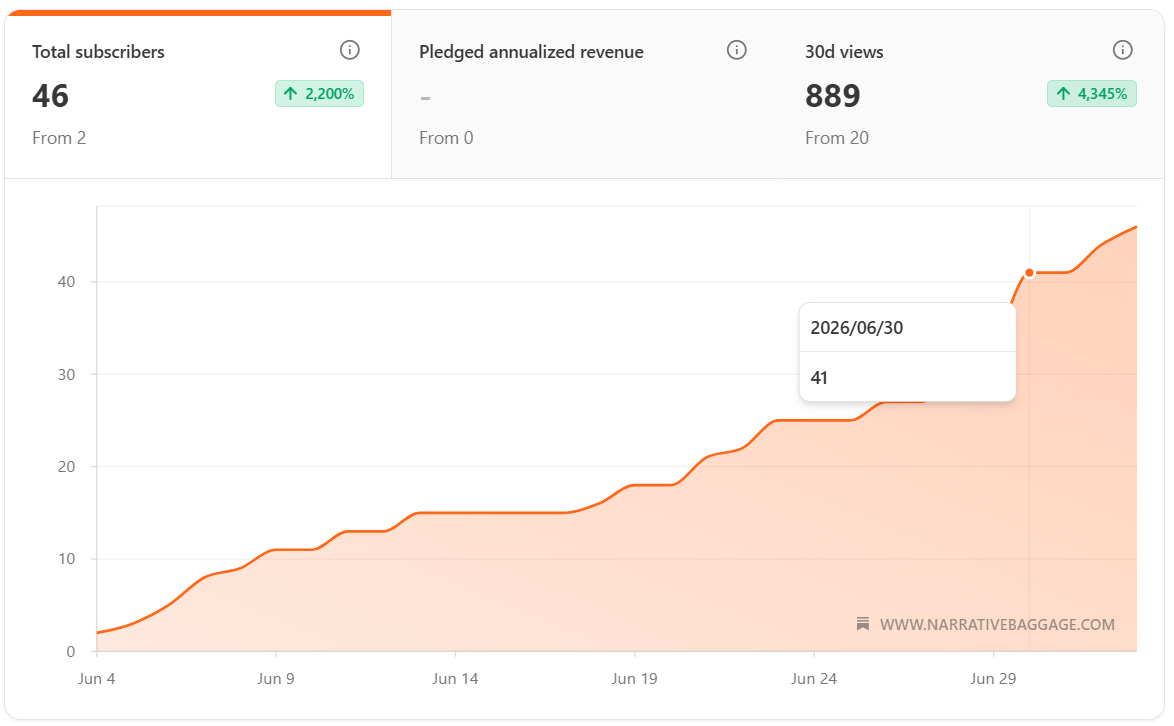
Subscribers: 41
Views: 889
Open rate: 42.86%
During June, I posted two articles:
Point of view in writing: the questions writers actually ask (and nobody seems to answer clearly)
How a strong narrative voice lets you get away with almost everything
And a number of 49 notes resulted in the graph you see below.
It’s important to mention that this reach was also possible thanks to friends or nice strangers restacking my notes.
The intention of my publication, Narrative Baggage, has always been to create an engaged community, learning, and connecting with other talented writers.
However, I still had numbers in mind to track my progress (again, I like graphs).
So, my initial goal was simple: get 100 subscribers by the end of the year.
As of June of 2026, I’m 41% there thanks to 41 people who either liked my articles, engaged with my notes, or thought the name of my publication was funny enough to give it a chance.
Now, here’s how I did it.
The “strategy”: what I did during the first month
To create community and subsequently get subscribers from that community, I came to realize that it was important to create anchors to connect with people. Those anchors being conversations. Conversations that started with a note, a comment, or an article I wrote.
I also read somewhere that a sweet spot for growth on Substack is to post three notes every day and two articles per week.
But that was… too much for me.
I wanted to make sure I could commit to an easy writing schedule first. So, my strategy, if you want to call it that, was:
Two articles a month on Saturdays
One note daily (and maybe a second, if I had ideas)
All of it, scheduled to go live at 6 am PT.
My first post was an introduction post:
Just to say “hi” and tell people why I was here. It did well, but honestly, I think it did well because my friend Alley restacked it and welcomed me into Substack.
From then on, I scheduled funny posts…
Bits of knowledge of what I learned as I write my book.
And sometimes daily progress on the actual writing of my book.
I didn’t think I’d find enough “material” to write a post every day. But as I planned them every week, I realized that you don’t need masterpieces. Just talk about things you learn, things that surprise you, or things that are funny to you.
You’ll find your people.
The results: more graphs on engagement, visitors, subscribers, and channels
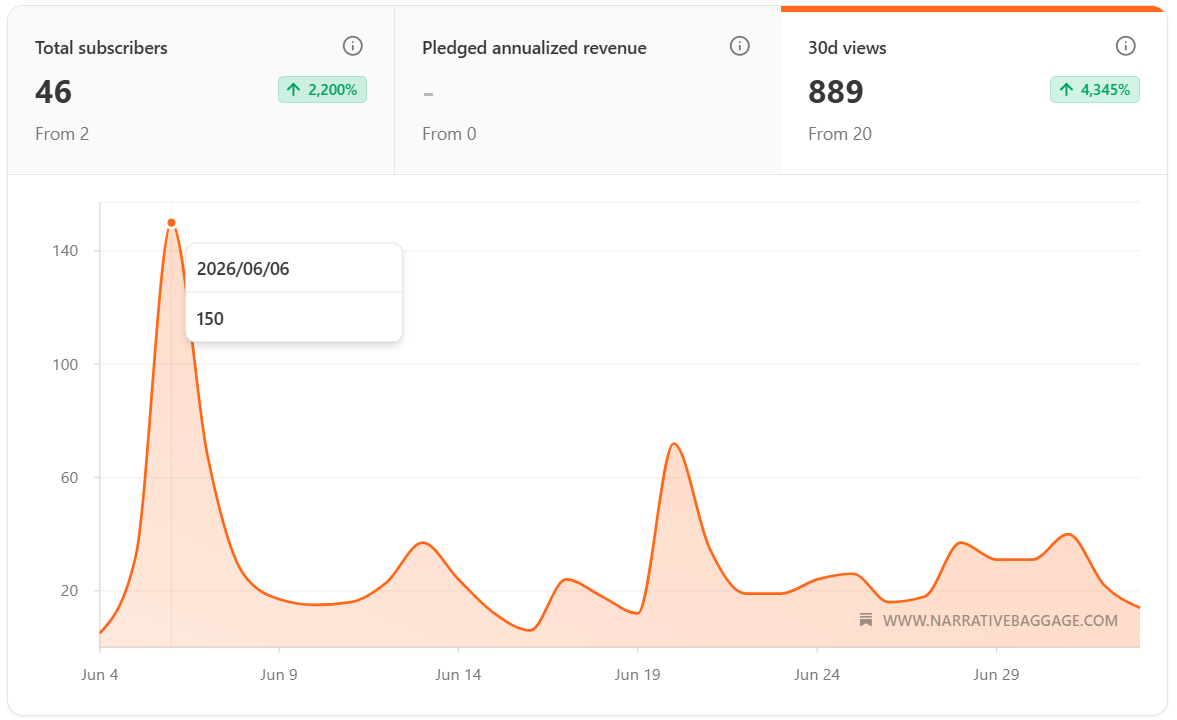
Views represent every time someone looks at a piece of content. Whether that’s on Substack, the web, or through email.
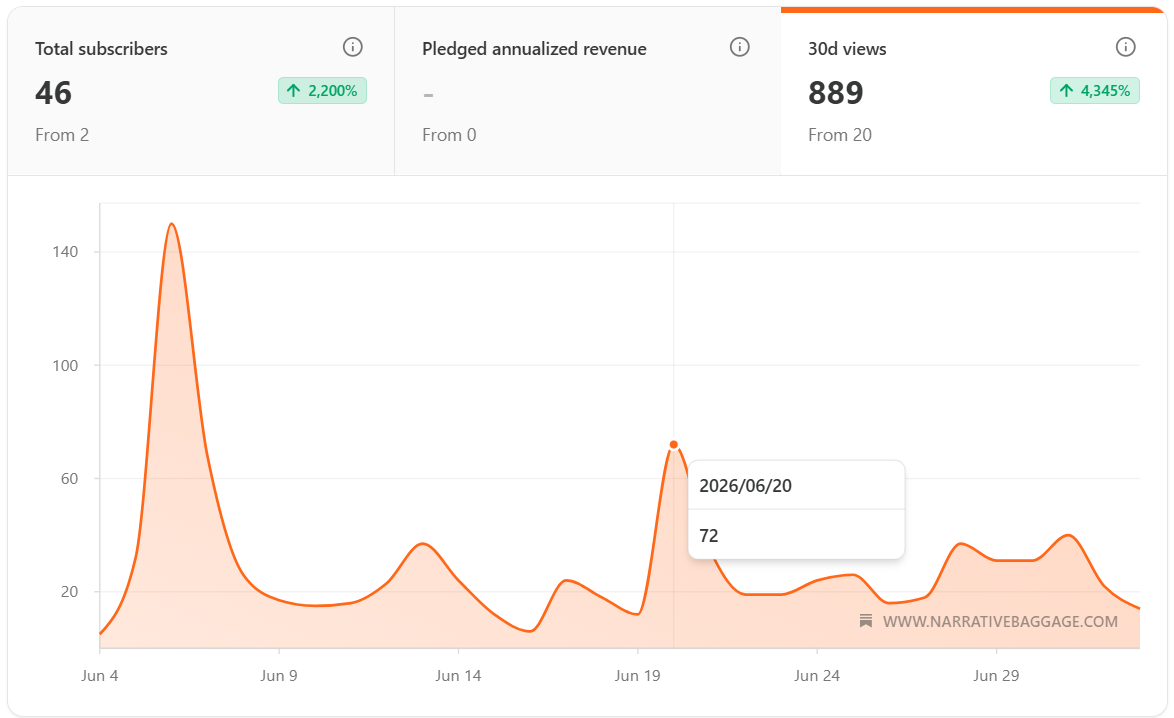
It seems I got the most views on June 6. The day I posted my first article, POV in writing (3k words), at around 150 views.
The second peak was on June 20, when I posted my second article on narrative voice (1.5k words) at 72 views.
What this tells me:
Engagement peaks or is higher on days I post articles on Substack. While Notes still bring impression (and by default views) every day, people stop scrolling to actually read or skim articles.
So, long-form content is still very much valuable (I knew y’all’s attention span wasn’t wrecked!)
However, it’s important to also notice the specific engagement metrics of each piece:

The POV in writing piece got the most views at the end of the month. But the second, and shortest piece, for narrative voice, got the most likes and comments, and almost reached the same amount of views as the first piece in just ten days.
This means that, while people appreciate a long 3k word well-researched piece, they have a life outside of Substack.
So, a shorter article that’s easy to consume in, say, 5-10 minutes represents less friction. And people are more willing to dedicate time to read it.
Next up: I’ll try to keep pieces around 1-2k words or at least a reading time of under 10 mins.
Where did visitors come from?
My graph on unique visitors tells a similar story.
Most visitors came from my two long-form pieces. But there are also two peaks at the end that are higher than in the previous graph.
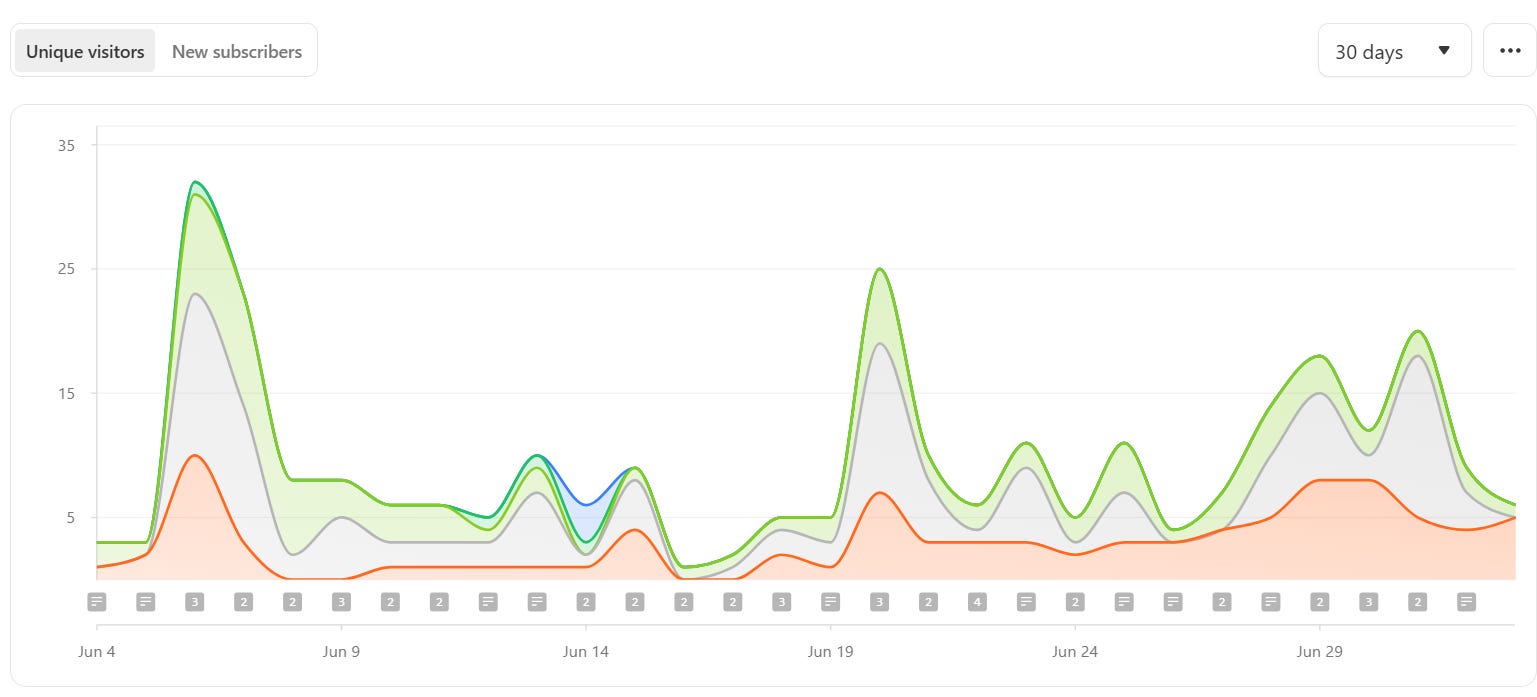
I’m assuming those come from these two Notes I posted by the end of the month. These got the most engagement out of any of my other notes.
People like connecting with others.
But they also appreciate bits of knowledge.
As for the sources of the visitors:
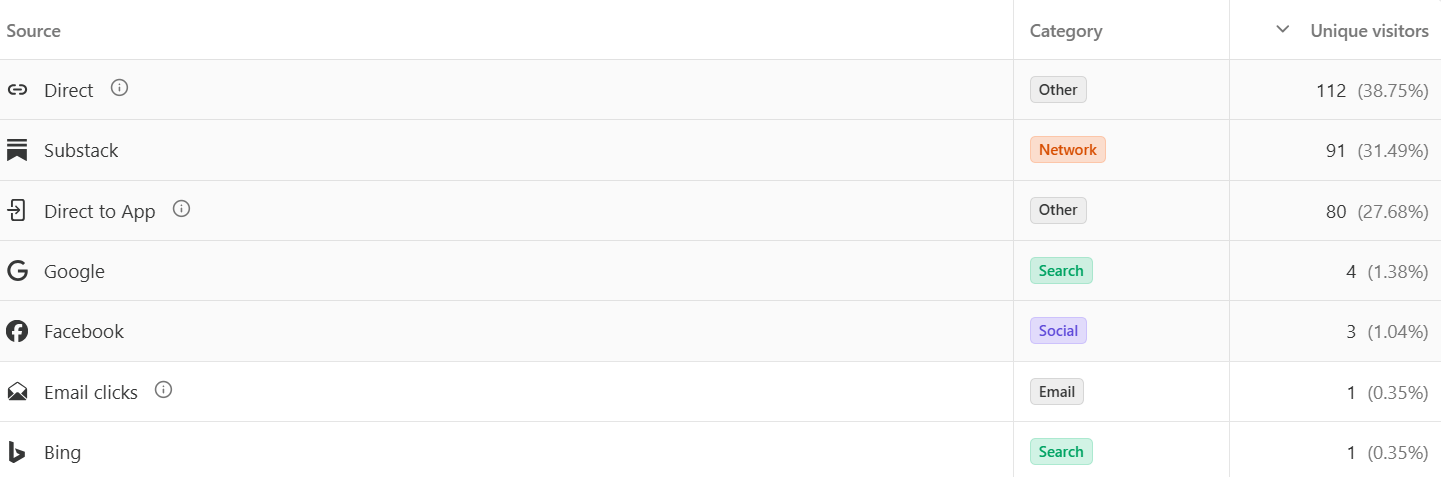
About 38% came from direct, which, according to Substack, means:
“These users arrived at your content by typing the URL or using a bookmark. It also includes traffic from sources that fail to pass referral data.”
And 31% came from Substack. I also had a few Google and Bing searches.
What did my subscriber growth look like?
I had 41 subscribers at the very end of June.
And as you can see, it’s not like I had a dramatic peak when it comes to people who willingly gave me access to their emails.
It was more of a steady growth.
Looking at the number of people who subscribed on a day-to-day basis, I would get one, two, or three subscribers daily.
Sometimes zero. On the highest days (which were three), I got four subscribers at most.
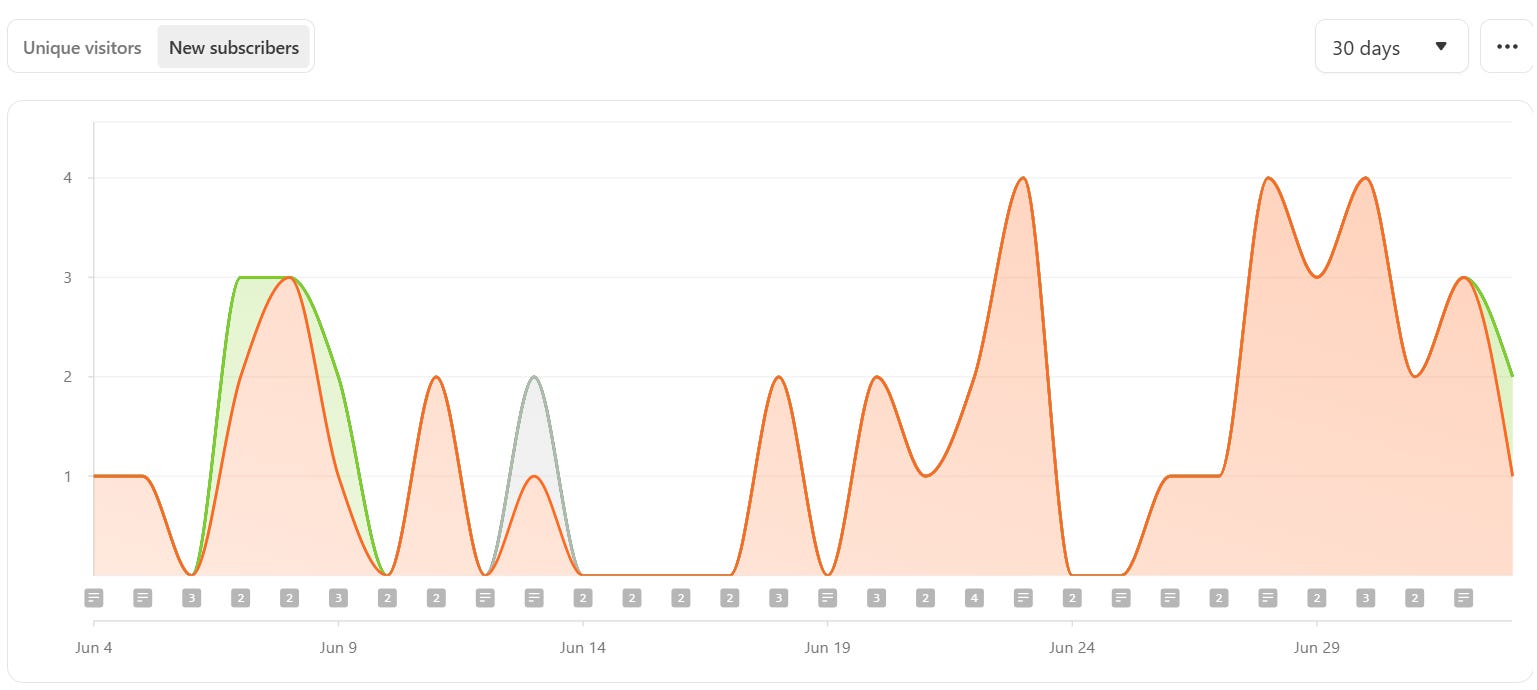
I love these numbers. Because growth is supposed to be boring. Steady and consistent, but boring.
Now, about 90% of subscribers came from Substack, which makes sense with everything we’ve been seeing and the fact that I only have a social presence as an author on this platform.

I have a feeling that most of my subscribers are people whom I have connected with through notes or by having conversations until they eventually gave me the opportunity to surprise them.
The 49 Notes that I posted this month?
Honestly, I just scheduled maybe 30 (one each day). The others came from restacks and things that I wanted to post about at the moment. But most were probably from my book progress.
The goal for June was to make it to the 30k word mark, and I reached that goal by July 3. A little late but still there.
And while my book goal is to write at least 10k words in a month, it may need some adjusting in July due to the Cozy Quill Fantasy Writing Contest.
What’s next?
Now that my first month is up, I’ll be applying what I learned.
I’ll try to post at least two Notes every day and one long-form post every week to see what happens. Consider it a little experiment.
This is my second post of July 2026. Let’s see if we can do two more.
Also, I promise that I’ll start adding cover images to my posts soon. I know that may affect my engagement too, and it’s just not a good look.
I’m very excited to see what this month brings, and I’ll update you with another one of these articles by then, here at Narrative Baggage.
Ready for month two?
Check it out for the same graphs with different numbers, more notes, and insights into what changed.
And scene
If you made it this far, you’re probably one of those readers who 100% their book. So, thank you for bearing with me until the end :)
If you found this article helpful (either as a writer or a lurker), consider following along as I figure out how to actually write that book.
And if there’s a writing topic you’d like me to write about, drop it in the comments.
Was this post helpful? What have you learned in your writing journey and as you grow on Substack?
Take care and keep writing. ✍️
That's awesome, Jesse! Congratulations on those stats! Thank you for sharing about your first month in Substack and what you've got planned. And thank you for the shoutout!
Ooo! I love some stats!